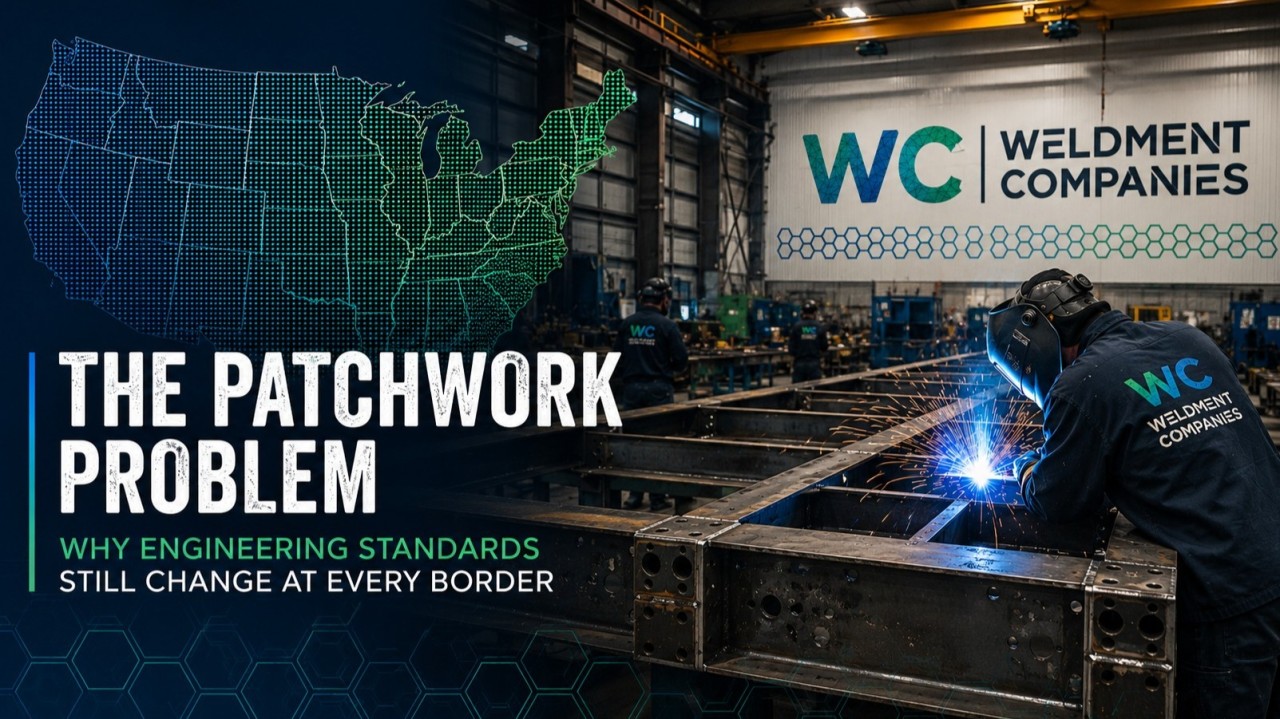
The Patchwork Problem: Why Engineering Standards Still Change at Every Border
The Issue at Hand
If you’ve practiced engineering across multiple states, you’ve seen it firsthand:
Same steel. Same physics. Same codes referenced on paper.
Yet completely different acceptance the moment you cross a line on a map.
After years working across industrial, marine, commercial, and heavy structural projects, I still come back to the same question:
Why?
The Illusion of Standardization
In theory, the U.S. has a unified engineering framework.
ICC model codes
ASCE 7 for structural loading
AISC for steel design
NCEES model law guiding licensure
On paper, it looks consistent.
In practice, it feels anything but.
Once you’re deep into real projects, fragmentation becomes obvious:
One jurisdiction uses the 2021 IBC… another is still on 2015
One city scrutinizes delegated engineering… another barely reviews it
One county requires stamped calculations for nearly everything… another lacks formal oversight entirely
Same structure. Same risk. Completely different expectations.
The Real Friction Isn’t Engineering—It’s Administration
Before you ever calculate a load or size a connection, you're already navigating:
Secretary of State registrations
Engineering board applications
State-specific Certificates of Authorization (COAs)
Tax registrations just to operate
Different renewal cycles and filing systems
Different interpretations of identical qualifications
You prove your competency once… then spend years proving it again in slightly different formats.
At some point, it stops feeling like engineering and starts feeling like administrative endurance.
A Moment That Says It All
I once had a board sincerely specialist thank me—not for solving a complex engineering problem—but for ensuring my business properly registered and compliant before sealing a document.
Not for protecting the public. Not for delivering quality work.
For navigating paperwork correctly.
That moment stuck with me.
Because safeguards absolutely matter—public safety, accountability, and standards are non-negotiable.
But somewhere along the way, parts of the system shifted from verifying engineering competence to verifying procedural navigation.
Where Regional Differences Do Matter
To be clear, not everything should be standardized.
A coastal structure in a corrosive hurricane zone should not be treated like a low-seismic inland structure.
Regional factors matter:
Wind
Seismic detailing
Snow loads
Corrosion
Local construction practices
But here’s the key distinction:
The engineering should vary. The process to prove you’re qualified shouldn’t.
A Better Approach: National Framework, Local Overlays
The solution isn’t eliminating regional nuance—it’s organizing it better.
Imagine a system with:
A unified national baseline
One adopted code cycle
One standardized licensure pathway
One engineering business registration framework
One clear definition of when PE involvement is required
Layered regional requirements
Coastal overlays
Seismic overlays
Wind overlays
Corrosion overlays
The design adapts where needed.
The bureaucracy doesn’t.
What This Could Look Like
You obtain a PE under a nationally aligned NCEES standard
Your exams, experience, and continuing education are tracked centrally
Your qualifications are recognized nationwide
States still maintain:
Authority
Oversight
Disciplinary control
But without 50 different versions of re-verifying the same engineer.
The same logic applies to engineering firms:
Register once. Qualify once. Operate everywhere.
Why This Matters
Right now, too much time in this industry goes into figuring out process instead of improving design.
Every hour spent untangling administrative requirements is an hour not spent on:
Constructability
Coordination
Safety
Detailing
Fabrication planning
Field execution
Meanwhile, the industry already operates nationally:
Fabricators cross state lines
EPC firms work nationwide
Manufacturers ship everywhere
Delegated engineers support projects across the country
The work is national.
The system isn’t.
The Opportunity
A more unified framework wouldn’t reduce engineering quality.
It would improve it through:
Clear expectations
Consistent standards
Transparent qualifications
Better accountability
Specialization wouldn’t disappear—it would become clearer:
Structural. Mechanical. Marine. Pressure vessels. Seismic systems.
These could exist as layered endorsements on top of a national PE framework.
The Reality
Gravity doesn’t change at the state line. Steel doesn’t care what jurisdiction it’s in. Failure doesn’t recognize political boundaries.
But the engineering process still does.
And that’s the part that doesn’t make sense.
Final Thought
Engineering should be difficult because the problems are difficult.
Not because the paperwork changes every 200 miles.
If we want better outcomes, the goal should be simple:
Create a system where engineers can focus on delivering safe, buildable, efficient projects—without constantly relearning administrative boundaries.
That’s how you improve speed. That’s how you improve quality. That’s how you reduce friction.
And ultimately, that’s how you put steel on the floor that works the first time.


