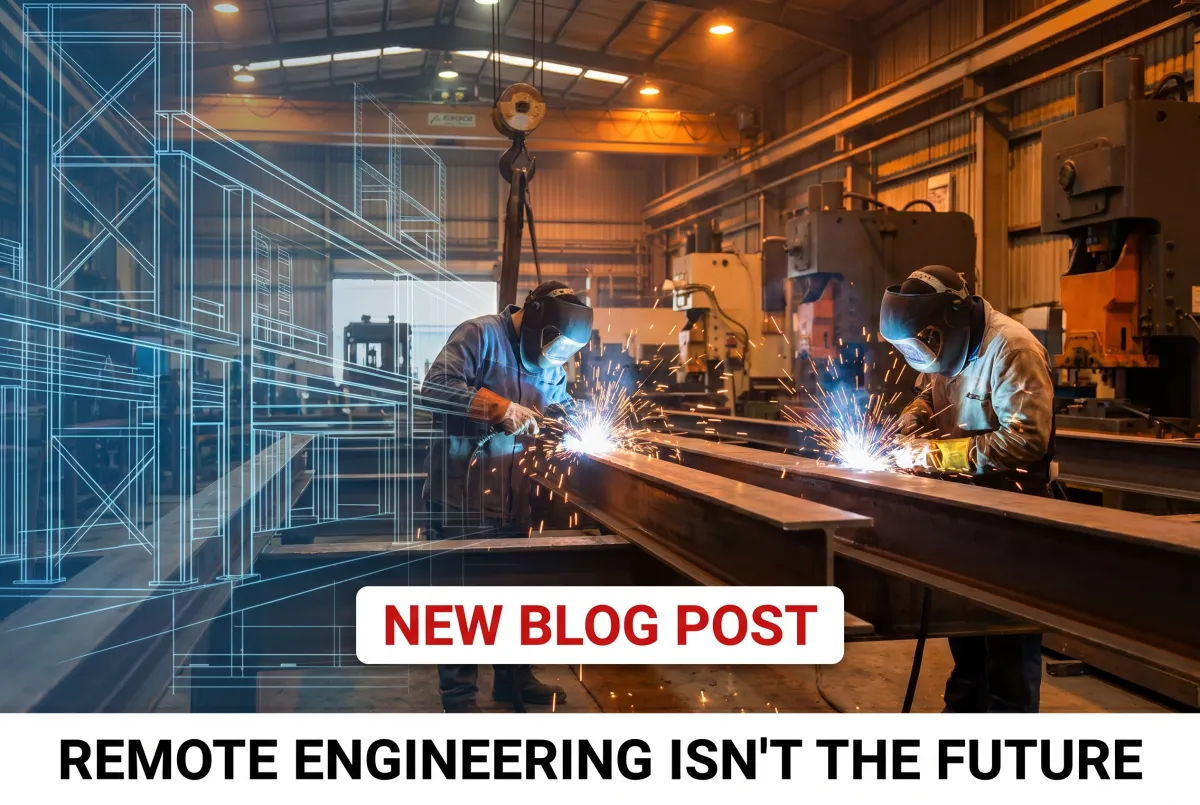
Remote Engineering Isn’t the Future. It’s the Advantage You’re Not Using Yet.
Most fabricators believe the solution to production pressure is simple: hire more engineers.
But in practice, that’s rarely the constraint.
What shops actually need is faster, qualified decision-making delivered at the moment production demands it.
Because fabrication doesn’t slow down due to a lack of effort or capability. It slows down when critical questions sit unanswered.
Where Time Is Actually Lost
It’s easy to assume inefficiency lives on the floor in cutting, fitting, or welding.
In reality, delays accumulate in the gaps between action and decision:
RFIs waiting in inboxes
Shop teams paused for clarification
Field conflicts without defined resolutions
Engineering teams buried under competing internal demands
You recognize it when a project feels like it’s “almost moving”… but never quite does.
And the shop waits.
The Structural Problem with the Traditional Model
The conventional approach is straightforward: Hire engineers. Add capacity. Keep up.
But engineering demand in fabrication environments is not linear—it’s volatile.
Internal teams are expected to handle:
Design development aligned with current standards
Connection detailing and review
RFIs and submittal responses
Shop support
Field issue resolution
This breadth of responsibility creates a bottleneck.
Not because engineers lack capability, but because they are forced to operate across too many priorities simultaneously.
When everything is urgent, response time suffers. And when response time suffers, production slows.
What Remote Engineering Actually Changes
Remote engineering is often misunderstood as a location shift.
It is not.
It is a shift in how engineering capacity is deployed.
Instead of embedding all expertise internally, remote support provides:
Engineers focused on rapid problem resolution
Availability aligned with production timelines, not internal scheduling
Experience rooted in real fabrication and field conditions, not just theoretical design
In practice, that means:
RFIs answered at an expedited rate
Shop issues resolved before escalation
Field changes addressed before impacting schedule
This is not a marginal improvement. It is a fundamental change in responsiveness.
Authority Still Matters: The Role of Licensure
Speed alone is insufficient without authority.
Engineering decisions must carry weight, especially when interfacing with Engineers of Record (EORs), General Contractors, and inspectors.
This is where licensed Professional Engineers (PEs) become critical:
Stamped calculations and responses reduce friction in approvals
Compliance with code requirements ensures decisions are defensible
Multi-state licensure enables seamless support across jurisdictions
Building this level of coverage internally is not just difficult, it’s expensive, slow to scale, and impossible without the right personnel on staff.
Remote engineering provides access to it immediately.
Engineering During Production: Where Value Is Created
Engineering is often perceived as a design-phase function.
In reality, its highest value emerges during production when conditions deviate from plan.
Consider the scenarios that actually disrupt schedules:
A connection detail conflicts in the field or doesn't exist
A tolerance stack-up prevents proper fit-up or was not considered
A weldment deforms during welding and use-as-is or scrap decisions are required
A below-the-hook lifting device requires calculations
At this stage, these are no longer design challenges.
They are production risks.
And they require:
Immediate technical evaluation
Practical, fabrication-aware solutions
Decisions that consider safety, compliance, and schedule simultaneously
The Cost Structure Few Discuss Honestly
Building a fully internal engineering team capable of handling this range is a significant investment:
Salaries and retention costs
Employee benefits and overhead
Software licensing (analysis, CAD, connection design tools)
Professional liability insurance
Ongoing training and code compliance
Multi-state licensing and administrative burden
Even with this investment, scalability remains limited.
When demand spikes, internal teams become constrained.
When demand drops, overhead remains fixed.
The Fractional Advantage
Remote engineering introduces a different model: fractional access to expertise.
Instead of hiring for peak demand, you gain:
Scalable support aligned with workload
Access to specialists across disciplines (structural, lifting, weldment design, etc.)
Reduced fixed overhead—paying for output, not idle capacity
Immediate integration of experienced engineers without long onboarding cycles
This is not outsourcing in the traditional sense.
It is strategic augmentation of your engineering capability.
Speed as a Competitive Advantage
On your best production days:
Decisions are immediate
Communication is clear
Work flows continuously
On your worst days:
Everyone is capable
Everyone is working
But no one has the answer fast enough
The difference is not skill.
It is response time.
The Real Question
The conversation should not be:
“Should we use remote engineering?”
It should be:
How quickly can we get qualified, code-compliant answers when production is on the line?
Because that determines:
Schedule performance
Margin protection
Risk exposure
Reputation in the field
Final Thought
Your shop does not need more engineers sitting in offices.
It needs access to the right expertise applied at the exact moment it’s required.
When that happens:
Production moves without interruption
Problems are resolved before they escalate
Engineering becomes a driver of efficiency, not a bottleneck
And jobs stop waiting.


